
Tennessee’s State Wildlife Action Plan: Our Blueprint for Nature

Take a deep dive into the TN SWAP, Tennessee’s State Wildlife Action Plan, and what it means for conservation courtesy of the TennGreen team.
There is a reason people come from across the world to wade Tennessee’s rivers, walk its ridgelines, and listen for birds in its bottomland forests: our state is one of the most biologically diverse inland states in the nation.
From the spruce-fir peaks of the Great Smoky Mountains to the cypress swamps of Reelfoot Lake, from the towering limestone bluffs of the Cumberland Plateau to the braided channels of the Mississippi Delta, Tennessee holds more species of freshwater fish, mussels, salamanders, and crayfish than nearly anywhere else on earth. Our caves alone shelter communities of life found nowhere else on the planet.
That extraordinary richness deserves an extraordinary protection plan. This winter, the Tennessee Wildlife Resources Agency (TWRA) and The Nature Conservancy (TNC) released Tennessee’s updated State Wildlife Action Plan—a sweeping, science-based roadmap for conserving the species and habitats that define our state. For TennGreen Land Conservancy, this moment represents years of collaborative work and a powerful new tool for protecting the places that matter most.
What is a State Wildlife Action Plan?
In 2001, Congress established the State and Tribal Wildlife Grants Program, requiring every state to develop a comprehensive strategy for conserving nongame wildlife—the vast majority of species that receive no dedicated funding through hunting or fishing licenses. Known as a State Wildlife Action Plan, or SWAP, these documents must be updated every ten years and serve as the nation’s primary framework for preventing future endangered species listings before a crisis occurs.
Tennessee’s new SWAP is the result of several years of intensive collaboration led by TWRA and The Nature Conservancy, drawing together the foremost scientific minds working across the state. Experts in aquatic species, birds, terrestrial wildlife, plant communities, cave ecosystems, and wildlife disease worked alongside conservation organizations, land managers, and agency partners to produce an updated plan that is more precise, more comprehensive, and more actionable than any that came before it.
TennGreen Land Conservancy was proud to be part of that effort.
FULL SWAP MAP
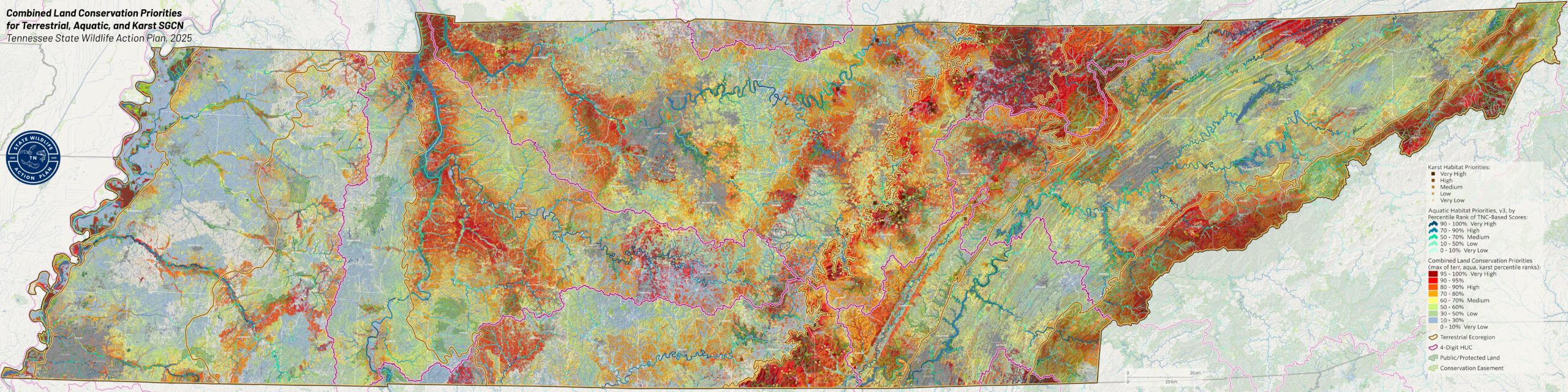
This map, the TN-SWAP 2025 Combined Land Conservation Priorities, combines terrestrial, aquatic, and karst priority zones for the entire state of Tennessee, showcasing which areas of our state are in urgent need of protection. The brighter the red burns on this map, the greater our conservation need.
Built by the Best
The panels and working groups behind Tennessee’s new SWAP represent decades of combined field experience and scientific expertise. Subject matter experts from universities, state and federal agencies, and leading nonprofits contributed their knowledge of aquatic systems, at-risk bird populations, terrestrial habitat, invasive species, wildlife disease, and more. The result is not just a data document—it is a living consensus among the people who know Tennessee’s wildlife most deeply.
TennGreen’s partnership in this process reflects our longstanding commitment to science-driven conservation. For more than two decades, we have worked alongside TWRA, The Nature Conservancy, the Tennessee Department of Environment and Conservation, and dozens of other partners to protect the lands and waters that Tennessee’s species depend on. Being at the table as this plan took shape means we are not simply reading its findings—we helped inform them.
EAST TENNESSEE

East Tennessee is where our state announces itself to the world. The Great Smoky Mountains National Park, the most visited national park in the country, anchors a vast mountain landscape of ancient ridges, clean headwater streams, and cove hardwood forests that harbor staggering diversity. But beyond the Smokies, East Tennessee encompasses the Ridge and Valley, the Upper Cumberland Plateau, the Clinch and Powell river systems, and the Cherokee National Forest—each with its own ecological character and its own roster of rare life.
A Region of Superlatives
The rivers of East Tennessee are among the most biologically important freshwater systems in the temperate world. The Clinch and Powell rivers alone support more species of freshwater mussels than all of Europe combined. These ancient waterways, carved over millions of years, shelter species of fish, mussels, and crayfish found nowhere else on earth—remnants of a biological heritage that survived the ice ages in Tennessee’s refugia.
The mountains themselves support plant communities more typically associated with Canada than the American South. Spruce-fir forests cloak the highest peaks, sheltering rare and endangered species like the Carolina northern flying squirrel. Lower elevations hold rich cove hardwood forests, among the most productive and diverse temperate forest types on the continent.
Key State Wildlife Action Plan Species


- Citico darter: a federally endangered fish found only in two small stream systems in Monroe County, dependent on clean, cold, fast-moving water
- Appalachian elktoe mussel: a federally endangered freshwater mussel of the Little Tennessee and Nolichucky river systems, highly sensitive to water quality
- Cerulean warbler: a neotropical migrant that nests in the high canopy of mature deciduous forest, declining across its range
- Green salamander: a rock-crevice specialist found on sandstone and limestone outcrops across the Cumberland Plateau and Ridge and Valley
- Cumberland rosinweed: a federally threatened plant restricted to a handful of limestone cedar glades and rocky woodlands
- Smoky madtom: a tiny, federally endangered catfish found only in Citico Creek and a few other tributaries of the Little Tennessee
- Eastern small-footed bat: a cave-roosting species increasingly threatened by white-nose syndrome, with key hibernacula in the region’s karst systems
What the SWAP Tells Us
East Tennessee holds significant concentrations of High and Very High Priority habitat, particularly along river corridors, in intact forested ridges, and in the karst systems of the Cumberland Plateau. Maintaining connectivity across this region, between public lands, private forest, and agricultural buffers along streams, is essential for both aquatic and terrestrial species. The SWAP identifies aquatic habitat as a top priority in the East, reflecting the extraordinary concentration of imperiled freshwater biodiversity.
MIDDLE TENNESSEE

Middle Tennessee sits at the geographic and ecological center of the state: a mosaic of cedar glades, karst springs, rolling Highland Rim forests, and river bottomlands that is every bit as biologically remarkable as the mountains to the east. It is also the region facing the most intense development pressure in the state, as Nashville’s rapid growth pushes outward into some of Tennessee’s most ecologically irreplaceable landscapes.
A Landscape Under Pressure
The Central Basin, ringed by the Highland Rim, is one of the most geologically distinctive landscapes in the eastern United States. Here, a shallow limestone bedrock supports unique plant communitie—cedar glades—that are found in significant extent only in Middle Tennessee. These sparse, sunbaked openings support an array of rare wildflowers, including Tennessee coneflower and limestone fame-flower, that have evolved to thrive in conditions most plants cannot survive. Several of these species were once listed under the Endangered Species Act and have recovered in part because of targeted conservation efforts… a success story worth celebrating and continuing!
The rivers of Middle Tennessee— including the Duck, the Harpeth, the Buffalo, the Caney Fork, and the Cumberland—support their own assemblages of rare fish and mussels, many of them endemic to the region. The West Harpeth, the Elk, and their tributaries flow through landscapes increasingly fragmented by development, making intact riparian corridors ever more important.
Key State Wildlife Action Plan Species


- Tennessee coneflower: a federally delisted wildflower that grows only in cedar glades of the Central Basin, one of conservation’s genuine recovery stories
- Barrens topminnow: a federally endangered fish of spring-fed streams and ditches in the Eastern Highland Rim, one of the rarest fish in North America
- Nashville crayfish: a federally threatened crustacean found only in the Mill Creek watershed within Davidson County, a casualty of urbanization
- Bald eagle: a conservation success story, now nesting regularly along Middle Tennessee rivers and reservoirs, dependent on healthy fish populations and clean water
- Loggerhead shrike: a declining grassland bird that requires open, shrubby habitat and native grasslands, increasingly rare as pasture is converted to subdivision
- Alligator snapping turtle: a massive freshwater turtle of larger river systems, in decline due to harvest pressure and habitat loss
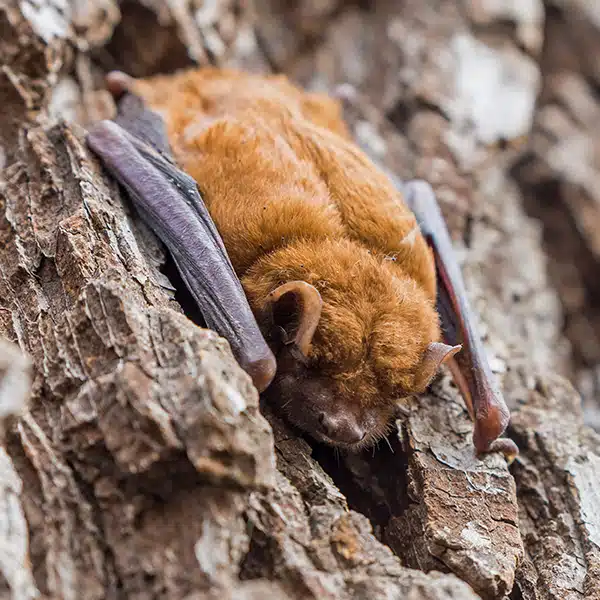
- Indiana bat: a federally endangered cave bat with critical winter hibernacula in Middle Tennessee, highly vulnerable to white-nose syndrome
- Little brown bat: once one of the most common bat species in the region, now in serious decline due to white-nose syndrome
What the SWAP Tells Us
Middle Tennessee contains some of the most urgent conservation priorities in the state, driven by the collision of high biological value and intense development pressure. The SWAP identifies the Highland Rim and Central Basin as areas where strategic private land conservation—conservation easements and targeted land acquisition—can have an outsized impact. With 28% of High and Very High Priority habitat statewide remaining unprotected, Middle Tennessee represents both the greatest risk and one of TennGreen’s most active conservation frontiers.
West Tennessee

West Tennessee is a different world. The landscape flattens and opens as you move west, giving way to the broad floodplains, river oxbows, and bottomland hardwood forests of the Mississippi Alluvial Plain—one of the most biologically significant and most altered landscapes in North America. Here, the Mississippi River and its tributaries have shaped a natural heritage unlike anything else in the state, and the conservation needs are as vast as the sky above the Delta.
A Lowland Legacy
Before European settlement, the Mississippi Alluvial Plain was covered by millions of acres of bottomland hardwood forest–a complex, flood-adapted ecosystem that supported extraordinary populations of waterfowl, wading birds, fish, mammals, and invertebrates. Drainage, clearing, and conversion to agriculture transformed the landscape dramatically. Today, the forests that remain are among the most ecologically valuable in the region, providing critical stopover habitat for millions of migrating birds along the Mississippi Flyway and sustaining remnant populations of species that depend on periodic flooding and mature forest structure.
Reelfoot Lake, in the far northwest corner of the state, is West Tennessee’s crown jewel—a shallow, cypress-studded lake created by the New Madrid earthquakes of 1811–1812, and one of the most productive and biologically diverse lakes in the country. Its waters teem with fish, its skies fill with eagles, herons, and pelicans, and its shallows nurture aquatic plants and invertebrates that support an entire food web.
The Hatchie River is one of the last free-flowing rivers of the Mississippi Alluvial Plain, a living remnant of what West Tennessee once was throughout.
Key State Wildlife Action Plan Species


- Interior least tern: a federally endangered bird that nests on sandbars along the Mississippi and lower Tennessee rivers, vulnerable to altered river flows and human disturbance
- Eastern black bear: returning to portions of West Tennessee after long absence, tracking bottomland corridors along the Mississippi and its tributaries
- Rafinesque’s big-eared bat: a cave-roosting bat that also uses hollow trees and old buildings in bottomland forest, declining as large-diameter trees disappear
- Paddlefish: an ancient, filter-feeding fish of large rivers, in decline due to overharvest and altered hydrology, now the subject of active restoration efforts
- Swallow-tailed kite: a spectacular, fork-tailed raptor that breeds in mature bottomland forest, with West Tennessee representing the northern edge of its range
- Prothonotary warbler: a cavity-nesting warbler of swamp forest and floodplain woodland, one of the birds most dependent on intact bottomland habitat
- Alligator gar: a substantial, ancient fish of large river systems and oxbow lakes, once heavily persecuted, now recognized as a vital part of healthy lowland river ecosystems
- Hatchie River crayfish: one of several invertebrate species dependent on the clean, intact waters of the Hatchie River system
What the SWAP Tells Us
The SWAP reinforces what conservation scientists have known for decades: the bottomlands and river corridors of West Tennessee are among the most underprotected and ecologically urgent landscapes in the state. Waterfowl, neotropical migrants, large mammals, and rare aquatic species all depend on a connected network of floodplain forest that is fragmented, shrinking, and under pressure. Private land conservation in West Tennessee, through conservation easements with farming families who have stewarded this land for generations, is not just a good idea – it is essential.
What Does All This Mean for Tennessee?
Across our Three Grand Divisions, the new State Wildlife Action Plan paints a picture that is both sobering and galvanizing:

Throughout the state, 37% of Tennessee’s lands rank as High to Very High Priority for wildlife conservation. Yet only 9% of that is currently protected while the remaining 28%—millions of acres of critical habitat—is unprotected and increasingly vulnerable to development, fragmentation, and land-use change.
That percentage gap is where TennGreen works.
Through the critical regional lens we’ve explored, the SWAP prioritizes and amplifies what makes Tennessee so special. East Tennessee’s mountains and valleys are fundamentally different from the Highland Rim, the Central Basin, or the Mississippi Alluvial Plain. The rolling plateaus and basins of Middle TN and the lowlands and river corridors of West TN are as exceptional as they are distinct. Each region is alive with the species that define them, the threats they face, and the conservation work underway to keep them whole.
And as the numbers show, Tennessee’s future cannot be secured on public land alone. One of the most meaningful additions to this updated plan is a dedicated chapter on private land conservation: an acknowledgment that the majority of our state’s most important habitats lie in private hands. Knowing this, voluntary conservation tools like conservation easements become essential to any serious, long-term strategy. TennGreen has championed this approach for years, and seeing it embedded in the state’s core conservation framework affirms both the need and the opportunity.
There is much more to be done. The SWAP is a beginning, not an end. It is an invitation to landowners, to donors, to partners, and to every Tennessean who has ever stood beside a clean stream or heard a wood thrush singing in the morning to join in the work of protecting what we love.
From Data to Land: How TennGreen is Putting the Swap to Work
A plan is only as powerful as the action it inspires.
For TennGreen Land Conservancy, the SWAP significantly strengthens our Strategic Land Conservation Plan by providing updated habitat data, refined species information, and a clearer picture of where development poses the greatest threat. That means every conservation easement, land acquisition, and landowner partnership can be focused where it will make the greatest difference.
As we continue our work across Tennessee, the SWAP will help us identify the highest-priority lands within our established Focal Areas, ensuring that conservation decisions are guided by the best available science and lasting conservation value.
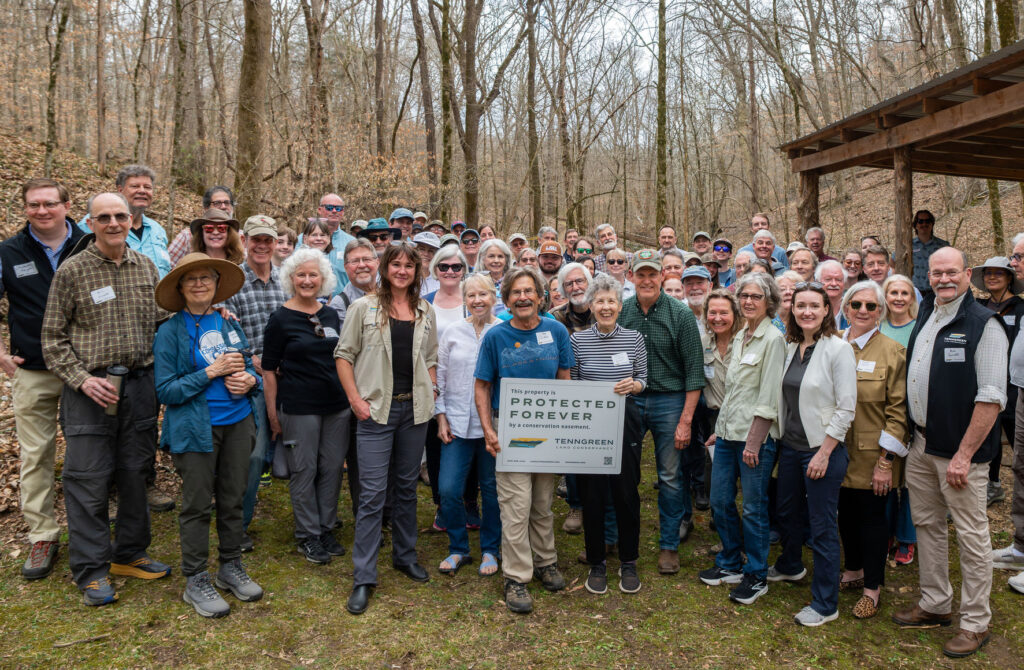
Again, the SWAP also reinforces an important reality: Tennessee’s wildlife future depends on private landowners. For more than two decades, TennGreen has partnered with families, farmers, and forest owners who want to leave their land better than they found it. Through voluntary conservation easements, landowners can permanently protect wildlife habitat while continuing to own, farm, hunt, and pass their property to future generations.
The SWAP helps reveal the broader significance of such impactful decisions. A protected farm may preserve a vital wildlife corridor. A conserved forest may safeguard habitat for dozens of rare species. Every protected property becomes part of a larger conservation network that benefits both people and wildlife.
We are grateful to the Tennessee Wildlife Resources Agency, The Nature Conservancy, and the many partners who developed this important plan. TennGreen is proud to help put it into action.
The science is clear. The priority lands are known. Now we need the partnerships and resources to protect them. Whether you choose to conserve your land or support this work through a charitable gift, you can help ensure that Tennessee’s most important landscapes endure for generations to come.
The plan exists. The priority lands are mapped. The window to protect them is open—but it will not stay open forever.
Now is the time.
For more information on the Tennessee State Wildlife Action Plan, visit their website at TNSWAP.com.